Moisture is one of the biggest causes of product damage during storage, transportation and export shipping. From food products and pharmaceuticals to electronics, leather goods and industrial components, excess humidity can reduce product quality, create mould, cause corrosion and lead to costly losses.
One of the most common questions packaging buyers ask is:
How much silica gel do I actually need?
The answer is not simply 1g, 5g or 10g. The correct silica gel quantity depends on the packaging volume, storage duration, product sensitivity, humidity conditions and whether the shipment is domestic or international.
This guide explains how to select the right silica gel pouch size for different applications and when a larger moisture-control solution may be required.
What Determines the Required Silica Gel Quantity?
Silica gel should always be selected according to the packaging environment rather than the product weight alone.
The most important factors include:
- Internal package volume
- Type of packaging material
- Product sensitivity to moisture
- Storage duration
- Transportation conditions
- Relative humidity during packing
- Domestic or export shipment
- Temperature fluctuations during transit
A properly selected desiccant helps maintain lower humidity inside sealed packaging and protects the product throughout storage and transportation.
Important: There is no single universal silica gel quantity suitable for every product. Final dosage should always be validated according to your packaging design and application requirements.
How Silica Gel Works Inside Packaging
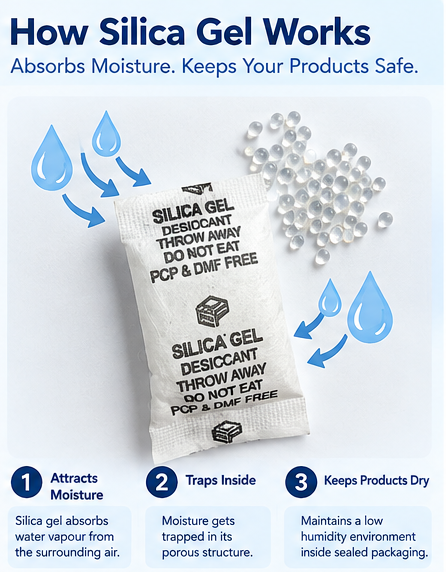
Silica gel is a porous desiccant that adsorbs water vapour from the air inside sealed packaging.
Instead of absorbing liquid water directly, silica gel captures moisture molecules within its microscopic pores, helping reduce humidity around the packaged product.
For the best performance, silica gel should be used inside properly sealed packaging such as:
- Plastic pouches
- Zipper bags
- PET jars
- HDPE containers
- Corrugated cartons
- Metal cans
- Export packaging boxes
- Laminated flexible packaging
If the package remains open, the silica gel will continuously absorb moisture from the surrounding environment instead of protecting the enclosed product.
Choosing the Right Silica Gel Pouch Size
Different industries require different pouch sizes depending on the packaging volume and moisture risk.
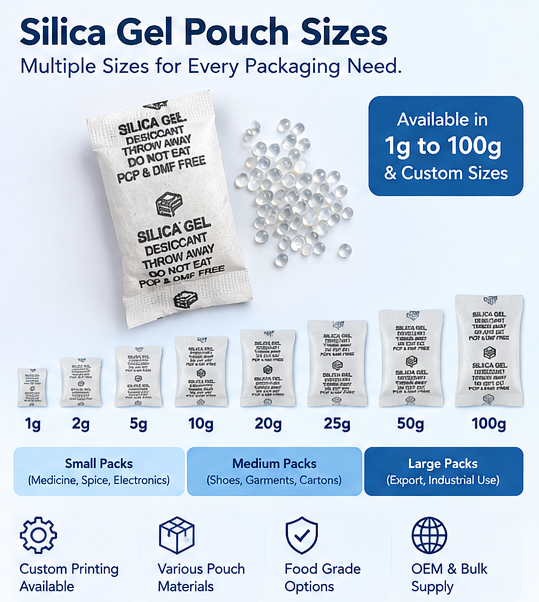
Below is a practical guide for commonly used silica gel sachet sizes.
| Silica Gel Size | Typical Application |
| 1g | Small pharmaceutical bottles, medicine packs, compact food packs |
| 2g | Nutraceutical jars, spice packs, small electronics |
| 5g | Dry food packaging, leather accessories, cosmetic packaging |
| 10g | Shoes, handbags, medium retail cartons |
| 20g | Garments, electronics cartons, industrial packaging |
| 25g | Larger cartons and moisture-sensitive products |
| 50g | Export cartons and heavy industrial packaging |
| 100g | Large export boxes and bulk storage applications |
These sizes are commonly used across packaging industries; however, the final selection should depend on the actual package dimensions and required shelf life.
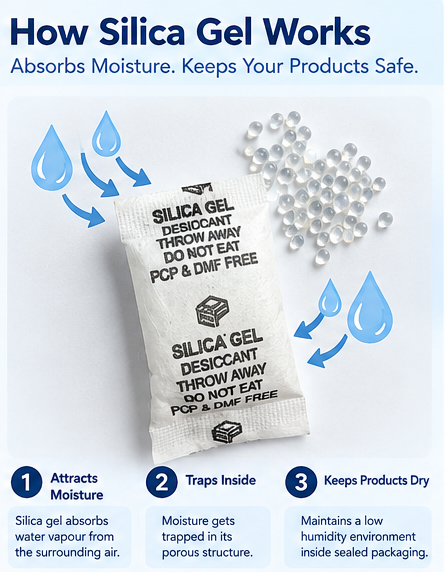
How Much Silica Gel for Food Packaging?
Food packaging requires careful moisture control because excess humidity can affect texture, crispness and shelf life.
Silica gel is commonly used for moisture-sensitive dry products such as:
- Biscuits
- Cookies
- Crackers
- Spices
- Dry fruits
- Nuts
- Instant coffee
- Milk powder
- Nutritional supplements
For food packaging, the correct pouch size depends on the package volume and barrier properties of the packaging material.
A small retail pouch may require a compact desiccant sachet, while larger jars or bulk food packs may require a higher moisture-control capacity.
Always ensure that the selected silica gel and pouch material are suitable for the intended food packaging application.
How Much Silica Gel for Pharmaceutical Products?
Pharmaceutical and nutraceutical products are highly sensitive to humidity.
Silica gel is widely used in:
- Tablet bottles
- Capsule containers
- Vitamin jars
- Diagnostic kits
- Medical devices
- Healthcare packaging
In pharmaceutical packaging, even a small increase in humidity can affect product stability.
Instead of selecting silica gel based only on weight, manufacturers generally consider:
- Bottle size
- Closure type
- Shelf life
- Packaging barrier
- Moisture sensitivity of the formulation
For regulated pharmaceutical applications, packaging validation is always recommended before commercial production.
How Much Silica Gel for Electronics?
Electronic products are vulnerable to humidity during storage and transportation.
Moisture can contribute to:
- Corrosion
- Oxidation
- Reduced insulation performance
- Damage to sensitive electronic components
Silica gel is commonly placed inside:
- Electronic equipment boxes
- Camera packaging
- Mobile accessories
- PCB cartons
- Instrument cases
- Electrical components
For electronics, multiple small sachets distributed inside the packaging often provide better moisture coverage than placing one large sachet in only one corner.
How Much Silica Gel for Shoes, Leather & Garments?
Leather and textile products naturally interact with moisture from the surrounding environment.
During long storage or export shipments, humidity can contribute to mould growth and unpleasant odours.
Silica gel is frequently used in:
- Shoe boxes
- Handbags
- Leather wallets
- Garment cartons
- Textile packaging
- Fashion export shipments
The required quantity depends on the carton size, packaging density and expected transportation duration.
For export shipments, moisture exposure is generally higher than short domestic deliveries, making correct desiccant selection even more important.
How Much Silica Gel for Export Packaging?
Export packaging deserves special attention because products may travel through different climate zones before reaching the final destination.
During international shipping, packages can experience:
- High humidity at ports
- Temperature fluctuations
- Long storage periods
- Sea transportation
- Condensation inside containers
For export cartons, the silica gel quantity should be selected after considering:
- Carton dimensions
- Product material
- Number of units per carton
- Shipping duration
- Destination climate
- Outer packaging barrier
For large sea shipments, silica gel sachets inside individual cartons may not be enough on their own. Container-level moisture protection solutions such as container desiccants may also be considered depending on cargo and route conditions.
Can You Calculate Silica Gel by Product Weight?
A common misconception is that silica gel should be selected according to the weight of the product.
For example:
- 1 kg product = 1g silica gel
- 5 kg product = 5g silica gel
This is not a reliable method.
The moisture present inside a package is influenced much more by the enclosed air volume, packaging material and environmental conditions than by the product weight itself.
Two products weighing the same may require completely different desiccant quantities if their packaging dimensions are different.
Therefore, packaging volume is generally a more meaningful starting point than product weight alone.
How to Choose the Correct Silica Gel Size
Before selecting a silica gel pouch, evaluate these five questions:
1. What is the package size?
Measure the internal dimensions of the pouch, carton, bottle or container.
2. What is the product?
Food, pharmaceuticals, electronics, garments, leather and industrial products all have different moisture sensitivities.
3. How long will the product remain packed?
A product stored for 30 days requires different protection than one exported for several months.
4. Is the packaging properly sealed?
Silica gel performs best inside well-sealed moisture-resistant packaging.
5. Is it a domestic or export shipment?
Export shipments usually face more demanding environmental conditions and longer transit durations.
Silica Gel for Different Industries
Food Industry
Used for dry food, spices, biscuits, nutraceuticals and powdered products where moisture can reduce quality.
Pharmaceutical Industry
Suitable for bottles, capsules, tablets and medical packaging requiring controlled humidity.
Electronics Industry
Protects sensitive components, instruments and electronic accessories against moisture exposure.
Leather & Footwear
Helps reduce humidity inside shoe boxes, handbags and leather packaging during storage and transport.
Textile Industry
Used inside garment cartons and export packaging to support moisture protection during logistics.
Industrial Manufacturing
Applied in machinery parts, automotive components, electrical equipment and precision instruments.
Silica Gel vs Container Desiccant
Although both products control moisture, they serve different purposes.
Silica Gel Sachets
- Used inside individual product packaging
- Ideal for retail packs, bottles and cartons
- Available in small gram sizes
- Suitable for localized moisture protection
Container Desiccants
- Used inside shipping containers
- Designed for long-distance sea freight
- Helps manage humidity within the container environment
- Commonly used for export cargo and bulk international shipments
For export businesses, both solutions may be used together depending on the packaging structure and cargo requirements.
Common Mistakes When Using Silica Gel
Avoid these common mistakes to achieve better moisture protection.
Using Too Little Desiccant
Insufficient moisture protection may increase the risk of humidity-related product damage.
Choosing Only by Product Weight
Always consider package volume and storage conditions instead of weight alone.
Using Silica Gel in Open Packaging
An open package allows the desiccant to absorb ambient humidity continuously, reducing its effectiveness.
Ignoring Export Conditions
International shipping often involves higher humidity exposure than domestic transportation.
Selecting the Wrong Pouch Material
Different applications may require paper, non-woven or other suitable packaging materials based on the industry and product requirement.
Need Help Selecting the Right Silica Gel Quantity?
Choosing the correct silica gel size is important for maintaining product quality while avoiding unnecessary packaging costs.
At EcoFreshGuard, we manufacture silica gel desiccant pouches in multiple sizes including 1g, 2g, 5g, 10g, 20g, 25g, 50g and 100g, along with customized packaging solutions for food, pharmaceutical, industrial and export applications.
We can also provide:
- Custom printed silica gel pouches
- OEM & private label packaging
- Food-grade and export-grade options
- Bulk manufacturing quantities
- Customized pouch sizes
- Technical support for packaging applications
If you are unsure which silica gel size is suitable for your product, our team can help recommend an appropriate solution based on your packaging dimensions and application.
Explore our Silica Gel Desiccant Pouches: https://ecofreshguard.com/silica-gel-desiccant-pouches/
Contact us for bulk requirements, samples or customized desiccant packaging solutions.
Frequently Asked Questions
How much silica gel should I use in a package?
The correct quantity depends on package volume, packaging material, storage duration, humidity conditions and product sensitivity. There is no single universal quantity suitable for every application.
Is 1g silica gel enough for every product?
No. A 1g sachet is suitable for certain small packages, but larger cartons, jars or industrial packaging may require higher-capacity desiccant pouches.
Which silica gel size is best for export packaging?
Export packaging depends on carton size, shipping duration and destination climate. Individual cartons may use silica gel sachets, while sea shipments may additionally require container desiccants.
Can silica gel be used for food products?
Yes, silica gel is commonly used in moisture-sensitive dry food packaging when supplied in appropriate food packaging formats. The pouch material and application should always be selected according to the packaging requirement.
Can silica gel protect electronics from moisture?
Yes. Silica gel is widely used inside electronics packaging, instrument cases and electrical component cartons to help reduce humidity during storage and transportation.
Does product weight decide silica gel quantity?
Not by itself. Package volume, sealing quality and environmental conditions are generally more important factors when selecting the correct desiccant quantity.
What silica gel sizes does EcoFreshGuard manufacture?
EcoFreshGuard manufactures silica gel desiccant pouches in 1g, 2g, 5g, 10g, 20g, 25g, 50g and 100g sizes, with customized packaging available for bulk and OEM requirements.
Explore more: